
How to Find Your Resting Heart Rate & What It Means


When you start training at The Pillars of Health I always recommend people do a few things to create a baseline for their general health and aerobic fitness.
Measure your Resting Heart Rate (RHR).
This is a vital first step to gain insight as to where your body is on the spectrum of being able to efficiently pump blood and oxygen to working muscles as well as being able to recover effectively. All things that we need to keep an eye on when it comes to longevity.
Your heart rate is how many times your heart beats in a minute.
Having a low resting heart rate is desired as this demonstrates that the heart is efficiently pumping blood and oxygen around the body with low stress on the heart but it also demonstrates the body can effectively recover from intensive exercise/stress.
HERE is a study showing the correlation between lower resting heart rates and risk of all cause mortality, specifically cardiovascular disease.
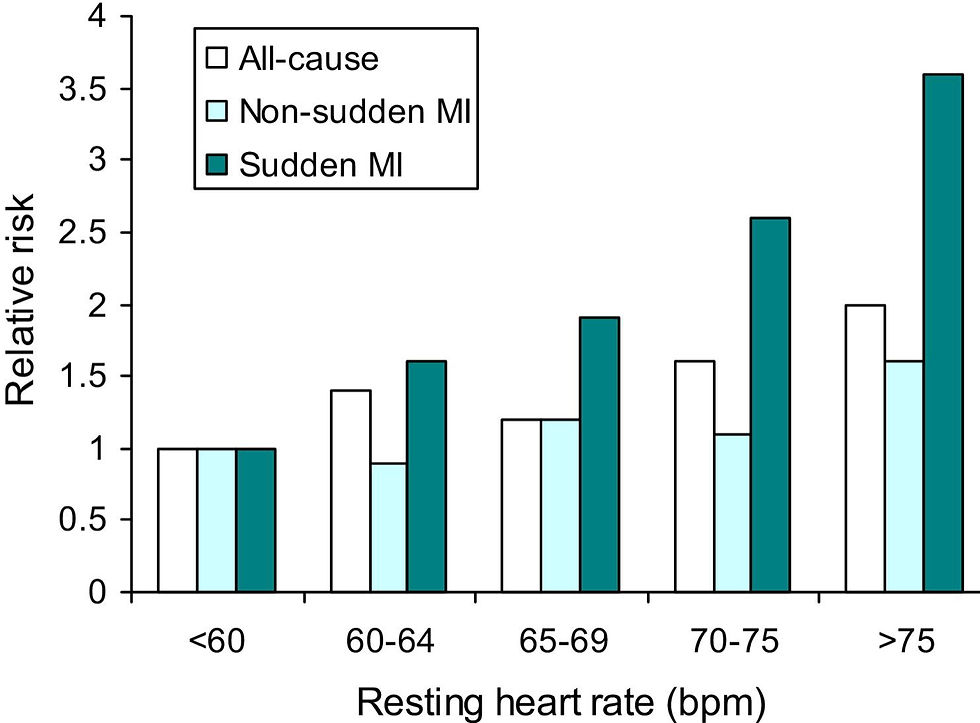
As you can see from the graph above, the higher your resting heart rate, the more risk you are exposed to of all cause mortality but also sudden and non sudden myocardial infarction.
How to Find Your Resting Heart Rate
Try this for three mornings in a row and calculate the average.
Upon waking up, as you're still laying supine in bed. Use your apple watch or another heart rate sensor to measure your heart rate. Here are the ideal ranges when it comes to resting heart rate.
Resting Heart Rate Range | Diagnosis |
40 - 49 bpm | Gold Standard |
50 - 59 bpm | Excellent |
60 - 69 bpm | Good |
70 - 79 bpm | Average |
80+ | Poor |
Now the above readings should be put into context. If you're an endurance runner then the 40 - 49 bpm range is very attainable. For most people, 50 - 59 bpm RHR is a great achievement and represents a healthy and efficiently functioning heart and aerobic system.
What Your Resting Heart Rate Means
if you're anywhere from 60 - 100 bpm you should incorporate some zone two conditioning. This is as easy as implementing two or three thirty minute walks per week. I do recommend using a heart rate sensor to make sure you're in the correct heart rate zone to benefit from your extra exercise.
I like using the MyZone Heart Rate monitor
If you have a stationary bike at home or access to one elsewhere, doing it on a bike of some sort is my preferred method.
Consistent zone two conditioning helps lower your resting heart rate and provides a wider foundation for your aerobic system to pull from when energy is in demand. This way you're not gassing out early as is the case with people who are relying more so on their anaerobic system.
Heart Rate Recovery
Heart rate recovery is another term a lot of members will have heard me talking about. This is the total beats your heart rate drops in sixty seconds following moderate to intense exercise.
For heart rate recovery we want to target 40 bpm or higher.
If your heart rate is slow to drop then you are generating energy anaerobically and you will fatigue quicker. This type of person would benefit from adding some zone two days as mentioned above.
If your heart rate is dropping 40 bpm or higher then you are generating energy aerobically and you can sustain energy output for longer and you can recover quicker.
Summary
The lower your resting heart rate the better your chance of living a longer life with less health implications along the way. The good news is, even if you currently have a high resting heart rate, you can train your heart to gain the desired effect and health outcome in around three to six months of consistent strength and aerobic training. The heart is another muscle after all.

Comments